Welcome to JIECHENG

Leave Your Message
0%

More and more, folks around the world are rethinking how buildings keep warm, block out noise, and handle fire risks. One solution that’s been gaining popularity is Thermal Fiber Insulation—it's pretty versatile and can be used in walls, roofs, floors, and even industrial equipment. But honestly, picking the right product isn’t always straightforward. Things like climate, how densely packed a building is, exposure to moisture, installation skills, and local building codes can all influence how well the insulation performs.

According to the International Energy Agency’s Energy Efficiency 2023 report, buildings are responsible for roughly 30% of global final energy use. They also generate nearly 26% of the world’s energy-related emissions. And the UNEP 2023 Global Status Report on Buildings and Construction shows that in 2022, buildings used up about 32% of global energy and were linked to 34% of worldwide carbon dioxide emissions. These numbers really put insulation into a whole new perspective—it’s not just about comfort anymore, it’s an energy management decision.

Arthur H. Rosenfeld, a renowned researcher in energy efficiency, once said, “The cheapest energy is the energy you don’t use.” That idea is what guides this review. We’re looking at ten different Thermal Insulation Fiber options—things like glass wool, mineral wool, cellulose, polyester, and sheep wool. When we compare them, we look at stuff like thermal conductivity, recycled materials, how they handle moisture, fire ratings, soundproofing, how long they last, and how easy they are to get, since all those things really matter on a construction site. For example, a dense batt might fit snugly between timber studs, while a loose-fill material could reach into irregular spaces more easily. And, of course, a cheaper option might mean more labor or other costs later on.

Now, no single ranking is perfect. Things like local standards and how well the installation is done can tilt the results. So, it’s smart to check test certificates and consider your specific project needs. But overall, this guide gives you a practical starting point to compare different Thermal Insulation Fiber options in various markets around the world.
Top 10 Thermal Fiber Insulation Types for Global Buyers

Top 10 Thermal Fiber Insulations: Scope, Definitions, and Buyer Criteria

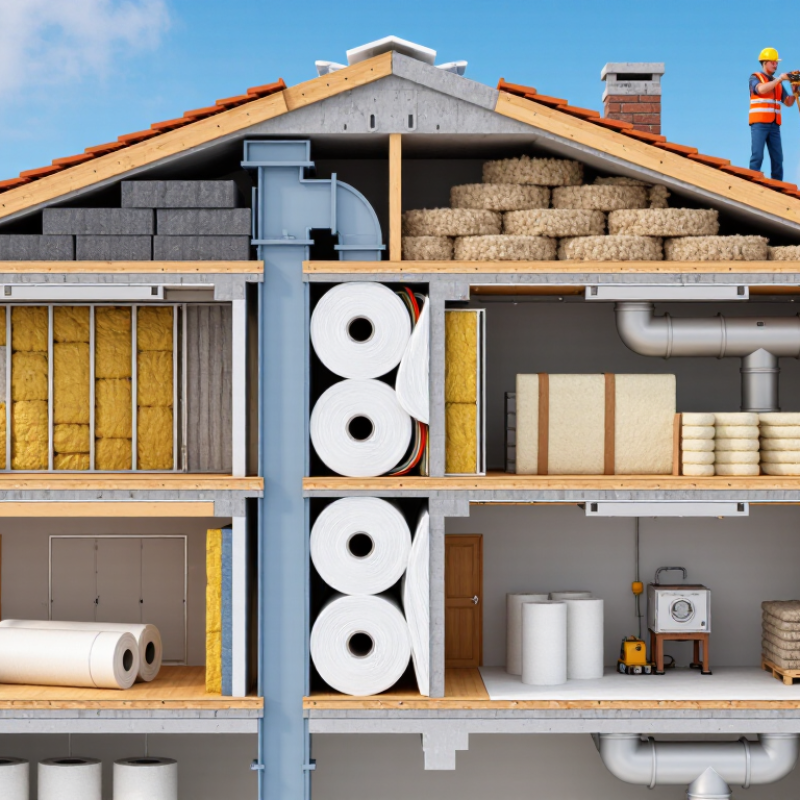
Thermal fiber Insulation Covers fibrous materials that slow heat transfer through trapped air, voids, or low-conductivity strands. For global buyers, the main scope includes buildings, HVAC systems, appliances, transport equipment, and selected industrial pipes. The ten common categories are fiberglass, rock wool, slag wool, ceramic fiber, cellulose fiber, sheep wool, cotton fiber, polyester fiber, recycled textile fiber, and aerogel-enhanced fiber mats. Each type behaves differently under heat, moisture, compression, and handling.

Fiberglass suits many walls and ducts because it is lightweight and widely available. Rock wool and slag wool offer strong fire resistance and better density for demanding assemblies. Ceramic fiber handles very high temperatures, but it needs careful exposure control during installation. Cellulose performs well in cavities, while sheep wool and cotton support lower-impact specifications. Polyester and recycled textile fibers resist moisture reasonably well. Aerogel-enhanced mats are thin and efficient, yet their purchase cost can be difficult to justify.

Buyer criteria should begin with required thermal resistance at the actual service temperature, not a catalogue value alone. Check thickness, density, compression recovery, moisture absorption, fire classification, fiber diameter, and installation limits. Request independent test reports and verify regional conformity requirements. In humid coastal projects, water behavior may matter more than peak R-value. My practical concern is simple: a perfect laboratory result can fail after poor fitting, gaps, or crushed sections. Buyers should also question unclear data, because not every supplier measures performance under comparable conditions.

Top 10 Thermal Fiber Insulation Types for Global Buyers

Typical thermal conductivity comparison for common fiber-based insulation categories. Lower values generally indicate better thermal resistance at the same thickness.

Buyer note: Values are representative midpoints of commonly reported conductivity ranges at typical test conditions. Actual performance varies with density, moisture content, temperature, compression, facing, and installation quality. For global purchasing, also verify fire classification, water resistance, recycled content, acoustic performance, thickness, and applicable regional standards.

Classify Fibers by λ (0.030–0.050 W/m·K), Density, and Binder Type

Thermal Fiber Insulation should be classified by tested lambda value, density, and binder type. ASHRAE Handbook—Fundamentals 2021 reports common fibrous materials near 0.030–0.050 W/m·K. Glass fiber often reaches 0.032–0.040 W/m·K. Mineral wool commonly falls between 0.034 and 0.041 W/m·K. Cellulose and wood fiber may approach 0.045–0.050 W/m·K. Lower lambda is useful, but laboratory results do not always reflect dusty, compressed installations.

For purchasing, a practical density split is low below 20 kg/m³, medium from 20–60 kg/m³, and high above 60 kg/m³. These bands are not universal. ISO 10456 and ASTM C518 emphasize declared conductivity, temperature, moisture, and aging conditions. A 40 mm low-density blanket may sag, while a denser board keeps its shape around a roof cavity. Check compression recovery.

Binder selection changes handling and long-term behavior. Phenolic or mineral binders can provide firm fiber locking and dimensional stability. Polyester binders often support flexible, low-dust batts. Acrylic and starch-based systems may serve projects seeking different emissions profiles, but performance depends on formulation. Binder-free products reduce added chemistry, yet they can require stronger facing or mechanical retention. That trade-off is easy to underestimate. Ask suppliers for density tolerance, binder percentage, fire classification, moisture conditioning, and third-party test reports before comparing price per square meter. The “best” lambda may not be the best installed value.

Mineral, Slag, and Glass Wool: λ 0.032–0.045 W/m·K; A1 Ratings

Fiber Insulation made from mineral, slag, and glass wool remains a practical choice for global construction buyers. Its thermal conductivity typically ranges from λ 0.032 to 0.045 W/m·K. Lower values usually indicate stronger insulation performance, but density and installation also matter. A compressed layer may lose effective thickness.

A1 ratings under EN 13501-1 indicate non-combustible performance for qualifying products. This matters around service shafts, façades, plant rooms, and industrial roofs. However, buyers should check the complete classification, not only an A1 claim. Facings, coatings, binders, and fixing systems can influence the tested assembly. Product documentation should include declared λ values, density, thickness, fire reports, and factory quality records.

In practical site checks, poorly fitted wool often creates narrow gaps around pipes and steel frames. Those small gaps can reduce real-world efficiency. Mineral wool offers robust fire resistance and sound control. Slag wool can provide useful thermal performance in heavy-duty applications. Glass wool is lighter and easier to handle in many wall and ceiling systems. The best option depends on climate, moisture exposure, transport limits, and local codes. The stated λ range is helpful, but it is not a promise for every installation. Temperature, aging, and workmanship deserve careful review.

Cellulose, Wood, and Hemp Fiber: λ 0.038–0.050 W/m·K; Moisture Data

Top 10 Thermal Fiber Insulation Types for Global Buyers

Cellulose, Wood, and Hemp Fiber: λ 0.038–0.050 W/m·K; Moisture Data

Cellulose, wood fiber, and hemp fiber usually deliver design λ values from 0.038 to 0.050 W/m·K. These figures align with ranges reported through EN 12667 testing and EN ISO 10456 design methods. Cellulose often sits near 0.038–0.042 W/m·K, while wood and hemp commonly reach 0.040–0.050 W/m·K. Lower density can improve sustainability, but it may reduce dimensional stability. Small details matter.

Moisture changes performance. Hygroscopic fibers absorb and release vapor, helping moderate indoor humidity. However, trapped water increases thermal conductivity and can support mold growth. European Commission Level(s) guidance recommends moisture-risk assessment during building design. Fraunhofer Institute hygrothermal studies also show that drying potential matters as much as initial insulation value. In practical inspections, a damp wall cavity feels cold, even when its calculated λ looks excellent. For Fiber Pipe Insulation , protect joints and outer coverings from rain intrusion. Hemp is promising, but published moisture data remains less consistent across test laboratories. That deserves caution.

Tips: Check declared λ, density, moisture content, and vapor resistance together. Request testing at realistic humidity, not only dry laboratory conditions. Leave a drainage or drying path where the assembly allows it. I would not select a fiber product from λ alone. A neat number can mislead.

Sheep Wool, Flax, Cotton, and Recycled PET: λ 0.035–0.047 W/m·K

Top 10 Thermal Fiber Insulation Types for Global Buyers

Thermal fiber insulation now extends beyond mineral and plastic-based products. The leading natural and recycled options include sheep wool, flax, cotton, recycled PET, cellulose, hemp, wood fiber, jute, kenaf, and recycled denim. Their declared thermal conductivity commonly falls between 0.035 and 0.047 W/m·K. Lower values indicate better heat resistance, but only at the tested density and moisture level.

Sheep wool often reaches approximately 0.035–0.042 W/m·K. Flax commonly measures near 0.037–0.040 W/m·K, while cotton and recycled PET may range from 0.039 to 0.047 W/m·K. These figures should follow EN 12667 testing and ISO 10456 design-value calculations.

The International Energy Agency’s Buildings 2023 report states that buildings consume about 30% of global final energy. Small conductivity differences can therefore influence long-term energy demand.

Performance is not only about λ. A humid warehouse, compressed bale, or poorly fitted corner can reduce real insulation value. Site checks often expose these gaps. Fire classification, vapor control, settling, density, and recycled-content verification deserve equal attention. The U.S. Department of Energy notes that installed insulation performance depends on material type, thickness, and workmanship. Lab numbers are useful, but they are not field guarantees. Global buyers should request declared values, test conditions, moisture limits, and regional compliance documents before comparing quotations.

Global Selection Matrix: R-Value, ASTM C518, EN 13162, Fire, and Cost

A practical ten-type screen may include glass wool, rock wool, slag wool, polyester, recycled PET, sheep wool, wood fiber, ceramic fiber, silica fiber, and aerogel fiber. Each material needs the same questions: declared R-value, test method, fire behavior, moisture response, and installed cost. R-value is not a fixed promise. Thickness, density, temperature, and compression can change the result.

ASTM C518 measures thermal transmission with a heat flow meter under controlled conditions. Ask for the tested temperature range and product thickness, not only a headline R-value. EN 13162 is mainly relevant to factory-made mineral wool products. It supports product classification and declared performance, while fire classification usually requires separate assessment under applicable European rules. The standards are useful, but they are not interchangeable.

For global buying, compare cost per installed square meter. Include cutting waste, freight volume, protective equipment, labor, and vapor-control details. Rock wool may cost more than glass wool, yet its fire performance can reduce secondary protection. Flexible PET fiber can fit uneven cavities, but compression may reduce thermal resistance. Fiber Insulation Tape helps seal joints, but it cannot correct poorly fitted insulation. The matrix is imperfect. I would recheck local climate data, certification scope, and supplier test reports before approving a purchase.

Top 10 Thermal Fiber Insulation Types for Global Buyers - Global Selection Matrix: R-Value, ASTM C518, EN 13162, Fire, and Cost
Rank Insulation Type Typical Form Thermal Resistance
R-Value per inch
ASTM C518 Relevance EN 13162 Relevance Typical Fire Performance Moisture / Durability Indicative Material Cost
USD/m² at 50 mm
Common Global Applications
1 Aerogel Blanket Flexible blanket or composite mat R-8.0 to R-10.0 Applicable for thermal conductivity testing; verify the product-specific report and test conditioning. Generally not classified under EN 13162; it is not a standard mineral-wool product. Usually non-combustible or limited-combustibility depending on the carrier and formulation; verify the declared Euroclass or local classification. Very low water absorption and excellent performance where thickness is restricted; handle carefully to prevent mechanical damage. Approximately $35-$90 Industrial pipework, equipment insulation, retrofit projects, high-temperature systems, and space-constrained assemblies.
2 Phenolic Foam Board Rigid faced board or pipe section R-7.0 to R-8.5 Commonly tested using ASTM C518 or equivalent thermal-conductivity methods; product construction affects results. Usually outside the scope of EN 13162; other European product standards may apply. Often achieves strong reaction-to-fire performance, but facings, joints, and installation details can change the classification. Low thermal conductivity and good dimensional stability; protect cut edges and joints from water ingress. Approximately $18-$40 External wall systems, roofs, floors, HVAC ductwork, and applications requiring high thermal performance at reduced thickness.
3 Polyisocyanurate (PIR) Board Rigid board with foil, kraft, or composite facing R-6.0 to R-7.2 ASTM C518 is commonly used to determine or verify thermal conductivity; declared R-value depends on thickness, aging, and temperature. Not normally covered by EN 13162; European PIR products are generally assessed under other applicable standards. Typically better fire performance than many thermoplastics, although facings and system design are critical; check the complete assembly classification. Closed-cell structure provides good moisture resistance; joints and penetrations require careful sealing. Approximately $12-$28 Commercial roofs, insulated panels, walls, floors, cold stores, and building-envelope upgrades.
4 Closed-Cell Spray Polyurethane Foam Site-applied sprayed foam R-6.0 to R-7.0 ASTM C518 may be used for laboratory thermal conductivity; field quality, density, aging, and application thickness are also important. Not covered by EN 13162; certification depends on the product system and national or European assessment route. Combustible material that normally requires a thermal barrier or protective covering in occupied building applications. Low water permeability and strong air-sealing capability; installation quality and substrate condition are critical. Approximately $15-$35 Irregular cavities, roofs, foundations, cold-storage structures, and air-sealing applications.
5 Extruded Polystyrene (XPS) Rigid closed-cell board R-4.5 to R-5.5 ASTM C518 is commonly used for thermal transmission testing; long-term thermal resistance should be considered where required. Not normally classified under EN 13162; other European standards apply to cellular plastic insulation products. Combustible and generally requires protection; fire behavior varies with formulation, thickness, and facing. Low water absorption, good compressive strength, and suitable for below-grade use; protect from solvents and prolonged UV exposure. Approximately $7-$18 Foundations, inverted roofs, floors, perimeter insulation, and areas requiring compressive strength and moisture resistance.
6 Expanded Polystyrene (EPS) Rigid molded bead board R-3.6 to R-4.2 ASTM C518 or comparable methods may be used; density and bead structure influence thermal performance. Not covered by EN 13162; European EPS products are generally assessed under standards for cellular plastic insulation. Combustible unless modified or protected; the complete wall, roof, or floor assembly must be evaluated. Moderate moisture resistance and good cost efficiency; drainage and protection are important in wet locations. Approximately $4-$12 External wall insulation, insulated concrete forms, packaging-related thermal uses, floors, and roofs.
7 Glass Mineral Wool Roll, batt, slab, or loose-fill fiber R-3.0 to R-3.8 ASTM C518 can be used for thermal conductivity; many products are also evaluated under product-specific ASTM insulation standards. Yes. Glass mineral wool is generally within the scope of EN 13162 when the product meets the standard's requirements. Typically Euroclass A1 or A2 for suitable unfaced products; facings, binders, and coatings may alter the classification. Fibrous and vapor-open; performance can decrease if heavily compressed or persistently wet. Good dimensional stability when properly installed. Approximately $3-$10 Residential and commercial walls, roofs, ceilings, HVAC systems, acoustic partitions, and industrial equipment.
8 Stone Mineral Wool Rigid or semi-rigid slab, batt, or pipe section R-3.0 to R-4.2 ASTM C518 is suitable for thermal conductivity measurement; density, orientation, and temperature affect the reported value. Yes. Stone mineral wool is generally covered by EN 13162 when the product meets the applicable requirements. Commonly Euroclass A1 for appropriate unfaced products; binders, facings, and installation systems must be checked separately. Non-combustible, vapor-open, and resistant to dimensional change; water-repellent grades are available for specific environments. Approximately $4-$14 Fire-rated walls, façades, roofs, industrial equipment, pipework, acoustic barriers, and high-temperature applications.
9 Cellulose Fiber Blown-in loose fill or dense-pack fiber R-3.2 to R-3.8 ASTM C518 may be used for laboratory thermal conductivity; installed density and settling must also be controlled. Not covered by EN 13162; cellulose products follow other applicable European or national assessment procedures. Usually treated with fire retardants; reaction-to-fire performance varies with formulation, density, moisture, and installation system. Hygroscopic and vapor-open; requires moisture management and correct installed density to limit settling. Approximately $3-$9 Attics, framed walls, retrofit cavities, timber buildings, and projects prioritizing recycled-content materials.
10 Sheep Wool Fiber Flexible batt or semi-rigid insulation mat R-3.5 to R-3.8 ASTM C518 may be used for laboratory thermal conductivity, but results depend on density, moisture, and test conditioning. Generally not classified under EN 13162 because it is an animal-fiber insulation rather than mineral wool. Usually requires treatment and protective construction; fire performance varies significantly by treatment and product assembly. Can buffer moisture vapor and maintain resilience; must be protected from persistent liquid water, pests, and compression. Approximately $10-$25 Residential walls, roofs, timber-frame buildings, renovation projects, and applications seeking bio-based materials.

Data notes: R-values are indicative product-range values in h·ft²·°F/Btu per inch at approximately 75°F (24°C). Actual declared values vary with density, thickness, moisture, aging, facing, and test conditions.

Standards note: ASTM C518 is a test method for steady-state thermal transmission properties and does not itself certify a product. EN 13162 applies primarily to factory-made mineral wool products. Fire classifications must be verified for the complete product or building assembly.

Cost note: Cost ranges are indicative material-only estimates in USD per square metre at 50 mm thickness and can vary substantially by region, quantity, logistics, labor, local regulations, and specification.

FAQS

What is thermal fiber insulation?

It uses fibers and trapped air to slow heat movement. Common applications include walls, ducts, appliances, vehicles, and pipes.

Which insulation types are commonly considered?

Options include glass fiber, rock wool, slag wool, ceramic fiber, cellulose, sheep wool, cotton, polyester, recycled textiles, and aerogel mats.

How should buyers compare thermal performance?

Compare tested thermal resistance at the actual service temperature. Check thickness, density, moisture, and compression conditions.

Is a published R-value always reliable?

Not always. Temperature, density, thickness, and compression can change performance after installation.

Which details matter in humid coastal projects?

Moisture absorption and drying behavior deserve close attention. A lower peak R-value may perform better when it stays dry.

How do fire requirements differ between materials?

Rock wool and slag wool generally provide strong fire resistance. Ceramic fiber handles extreme heat but needs careful installation controls.

What should buyers request from suppliers?

Request independent test reports, tested thickness, temperature ranges, fire results, and regional conformity documents.

How should total insulation cost be calculated?

Compare installed cost per square meter. Include freight, cutting waste, labor, protective equipment, and vapor-control work.

Can flexible insulation solve uneven cavities?

It can fit irregular spaces more easily. However, excessive compression may reduce thermal resistance.

What installation problem causes common failures?

Gaps, crushed sections, and poor joints can undermine laboratory performance. Sealing tape helps joints, but it cannot fix bad fitting.

Are test standards interchangeable?

No. Different methods may use different conditions and product scopes. Check the exact method and certification coverage.

What is the most practical buying caution?

Do not trust unclear data. Recheck climate conditions, installation quality, and comparable supplier measurements before approval.

Conclusion

This guide compares the top thermal fiber insulation types for global buyers by examining thermal conductivity, density, binder composition, moisture behavior, fire performance, and total cost. Thermal Fiber Insulation options are classified within a typical λ range of 0.030–0.050 W/m·K, helping buyers match material performance with climate, building design, and installation requirements. Mineral wool, slag wool, and glass wool generally provide λ values of 0.032–0.045 W/m·K and can achieve A1 fire classifications when properly specified. Cellulose, wood, and hemp fibers offer renewable alternatives, with λ values commonly around 0.038–0.050 W/m·K, while moisture control remains an important design consideration.

Sheep wool, flax, cotton, and recycled PET fibers provide additional choices, typically ranging from 0.035–0.047 W/m·K. A practical global selection matrix should compare R-value, test methods such as ASTM C518, relevant requirements including EN 13162, fire ratings, moisture resistance, durability, availability, and installed cost. This approach supports balanced decisions based on performance, safety, sustainability, and regional compliance.

Lila

Lila

Lila is a dedicated marketing professional at Jiangxi Jiecheng New Materials Co., Ltd., where she specializes in high-temperature insulation products. With a solid background in product knowledge and industry trends, Lila plays a pivotal role in promoting the company’s core offerings, which include......
Previous 2026 Best Heated Water Pipe Insulation for Global Buyers